Introduction: The Era of Hyper-Personalized Digital Experiences
In today’s digital landscape, user attention is a scarce and valuable resource. With the growing saturation of online content and offers, businesses face the challenge of standing out and creating meaningful connections with their audience. This is where Artificial Intelligence in Web Personalization emerges as a transformative tool, allowing brands to deliver tailor-made digital experiences that resonate individually with each visitor. Far from being a mere trend, AI-driven personalization is becoming a fundamental pillar for success in digital marketing and e-commerce.
This article explores how AI is reshaping how we interact with websites, from optimizing the customer journey to increasing conversion rates. We will cover essential concepts, tangible benefits, key applications, and strategies for effectively implementing AI personalization, ensuring your business not only attracts traffic but converts it into loyal customers.
What is Web Personalization with Artificial Intelligence?
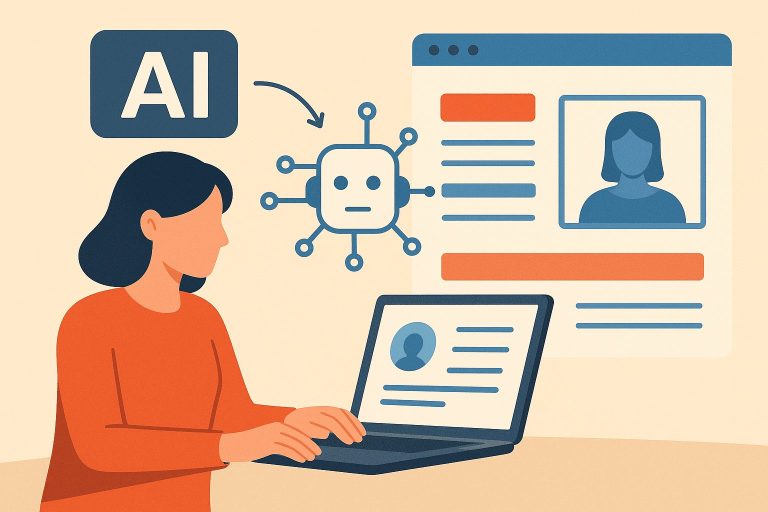
Web personalization with Artificial Intelligence refers to the use of AI and Machine Learning (ML) algorithms to analyze user data in real-time and dynamically adapt the content, design, and functionality of a website to individual preferences and behaviors. Unlike traditional segmentation, which groups users into broad categories, AI allows for personalization at a granular, almost one-to-one scale.
These AI systems collect and process a vast amount of data, including browsing history, past purchases, content interactions, demographic data, location, and even the device used. Based on this analysis, AI can predict user needs and interests, presenting information, products, or services that are most relevant to them at the right time.
Undeniable Benefits: Why Invest in AI for Personalization?
The adoption of AI in web personalization offers a series of competitive advantages that directly impact business performance:
1. Increased User Engagement
By presenting relevant content, AI captures and retains visitor attention for longer. A recent study revealed that 88% of marketers using AI report significant improvements in customer personalization [1]. This translates into more pages visited, longer time on site, and a more satisfying experience.
2. Improved Customer Experience (CX)
Users expect their online interactions to be intuitive and adapted to their needs. AI personalization meets this expectation, creating smoother and more pleasant journeys. Websites that offer personalized experiences are more likely to build customer loyalty and a positive reputation.
3. Conversion Rate Optimization
When a website displays products or information that directly matches user interests, the likelihood of them taking a desired action (such as a purchase, a download, or a form submission) increases exponentially. AI helps remove barriers and guides the user more efficiently through the sales funnel.
4. Competitive Advantage
In a saturated market, the ability to offer a superior digital experience can be the differentiator that puts your brand ahead of the competition. Companies that invest in AI personalization are positioned to innovate and lead in their respective niches.
5. Predictive Analytics and Data-Driven Decision Making
AI algorithms not only personalize but also generate valuable insights into consumer behavior. This predictive analysis allows businesses to anticipate trends, optimize marketing strategies, and make more informed decisions, resulting in a higher ROI (Return on Investment) [2].
Practical Applications of AI in Web Personalization
Artificial Intelligence can be applied in various ways to optimize personalization on websites:
a) Product and Content Recommendations
Recommendation systems are perhaps the most well-known application of AI in personalization. Platforms like Amazon and Netflix are masters at this, suggesting products or movies based on viewing history, purchases, and preferences of similar users. For an e-commerce site, this can mean displaying complementary items, best-selling products in the user’s browsing category, or exclusive offers.
b) Dynamic Website Content
The content of a website can change dynamically for different users. This includes banners, calls-to-action (CTAs), blog articles, and even page structure. For example, a returning visitor might see a personalized welcome message and offers based on their previous interactions, while a new visitor might be directed to introductory content.
c) Internal Search Optimization
AI can enhance a website’s internal search functionality by understanding the intent behind user queries and providing more accurate and relevant results, even with typos or synonyms. This is crucial for e-commerce and sites with vast content catalogs.
d) Chatbots and Virtual Assistants
AI-powered chatbots offer personalized, real-time customer support, answering questions, guiding users through navigation, and even assisting with purchase completion. They learn from each interaction, becoming more efficient over time.
e) Email Marketing and Push Notification Personalization
AI extends beyond the website, personalizing external communications. Marketing emails can be tailored with product recommendations, abandoned cart reminders, or relevant content, increasing open and click-through rates. Push notifications can also be sent more intelligently, at the ideal time and with highly targeted messages.
Strategies for Implementing AI Personalization
To reap the benefits of AI personalization, it is essential to adopt a strategic approach:
1.Define Your Objectives: First and foremost, determine what you want to achieve with personalization. Is it to increase sales? Improve engagement? Reduce bounce rate? Clear objectives will guide your strategy.
2.Collect Quality Data: AI is only as good as the data that feeds it. Invest in robust analytics tools (like Google Analytics 4) and ensure you are collecting relevant user behavior data ethically and in compliance with privacy regulations (LGPD, GDPR).
3.Choose the Right Tools: There are various AI platforms and solutions on the market, from recommendation tools to complete customer experience optimization systems. Evaluate your needs and budget to select the most suitable ones.
4.Start Small, Optimize Continuously: You don’t have to personalize everything at once. Start with high-impact areas, such as product recommendations or dynamic content on the homepage. Monitor results, learn from them, and iterate. Personalization is a continuous process of testing and optimization.
5.Integrate with Other Marketing Strategies: AI personalization should be part of an integrated digital marketing strategy. Combine it with SEO, content marketing, social media, and email marketing to maximize its impact.
The Future of Personalization: Generative AI and Beyond
The advancement of Artificial Intelligence, especially Generative AI, promises to take personalization to a new level. Instead of merely adapting existing content, AI will be able to create entirely new and unique content for each user in real-time, from product descriptions to blog articles and visual elements. This will open doors to truly unique and immersive experiences, where each interaction is a personalized conversation between the brand and the customer.
Conclusion
Artificial Intelligence in Web Personalization is no longer a luxury but a necessity for businesses seeking to thrive in the competitive digital environment. By investing in AI-driven personalization strategies, brands can create more relevant, engaging, and effective digital experiences, transforming visitors into loyal advocates and driving business growth. NWD is ready to help your company navigate this new era of personalization, building websites that not only impress but convert.